
Accuracy you can check
Accuracy and precision, measured by the validation pass built into the tracker’s software against targets not used for calibration. Participant testing is under way, and figures will be published when it is complete.
Accuracy and precision
Accuracy is the offset between the reported gaze point and the target. Precision is the scatter about that reported point while the eye holds still. Both are in degrees of visual angle; at 65 cm half a degree is about 5.7 mm on screen. A tracker can be good at one and poor at the other, so both are given.
Accurate, imprecise
Centred on the target but scattered. The average is right; a single sample may not be.
Precise, inaccurate
Tightly grouped, but off the target. Wrong by about the same amount each time.
Accurate and precise
Grouped and close to the target.
Testing
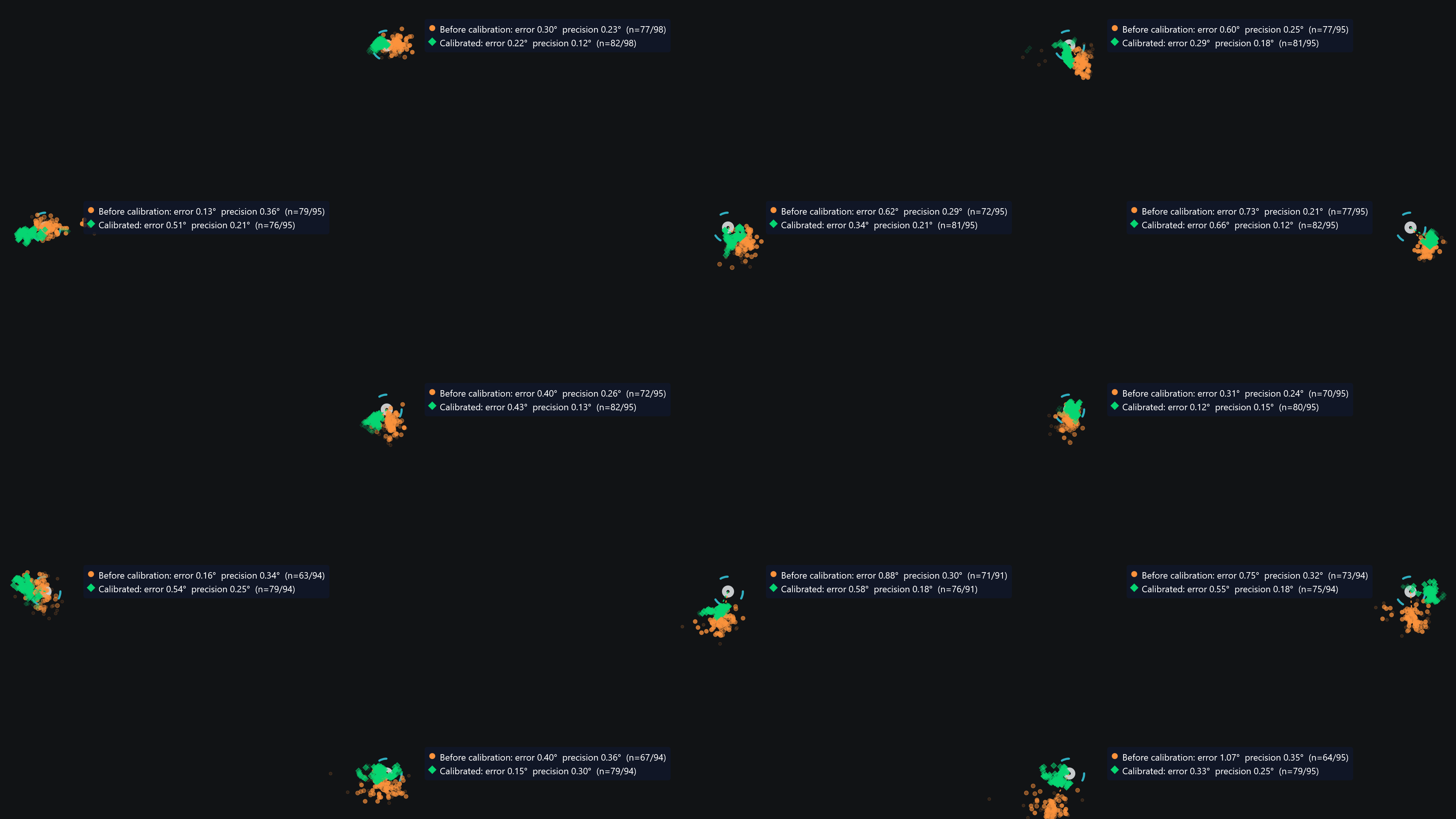
Participant testing is under way on the prototype. The production tracker uses a different camera, so its accuracy specification will be published once it has been measured, with the number of participants and sessions, and every run accounted for. The example below shows what a report contains.
What the report contains
The validation pass runs after calibration, on its own set of targets, and writes a report with the recording. It gives the error and the scatter at each target, the proportion of samples with valid gaze, and the viewing distance. Each session therefore has its own accuracy figure.
Distance, head movement and sampling
| Distance | 55 to 75 cm from the tracker, which sits just below the screen |
| Head support | None: no headrest or chin rest |
| One eye lost | Tracking continues on the other eye |
| Head-movement range | To be published for the production version when it has been measured |
| Sampling rate | 60 Hz, fixed for the length of a recording |
| Recording manifest | Reports the rate achieved, any gaps and the number of missing samples |